Vendorius B2B finds the companies that can buy what you sell, emails them and books the meeting in your calendar. We write about this because it is one of the things we see most often in campaigns that do not work.
Are the companies you email all at the same point?
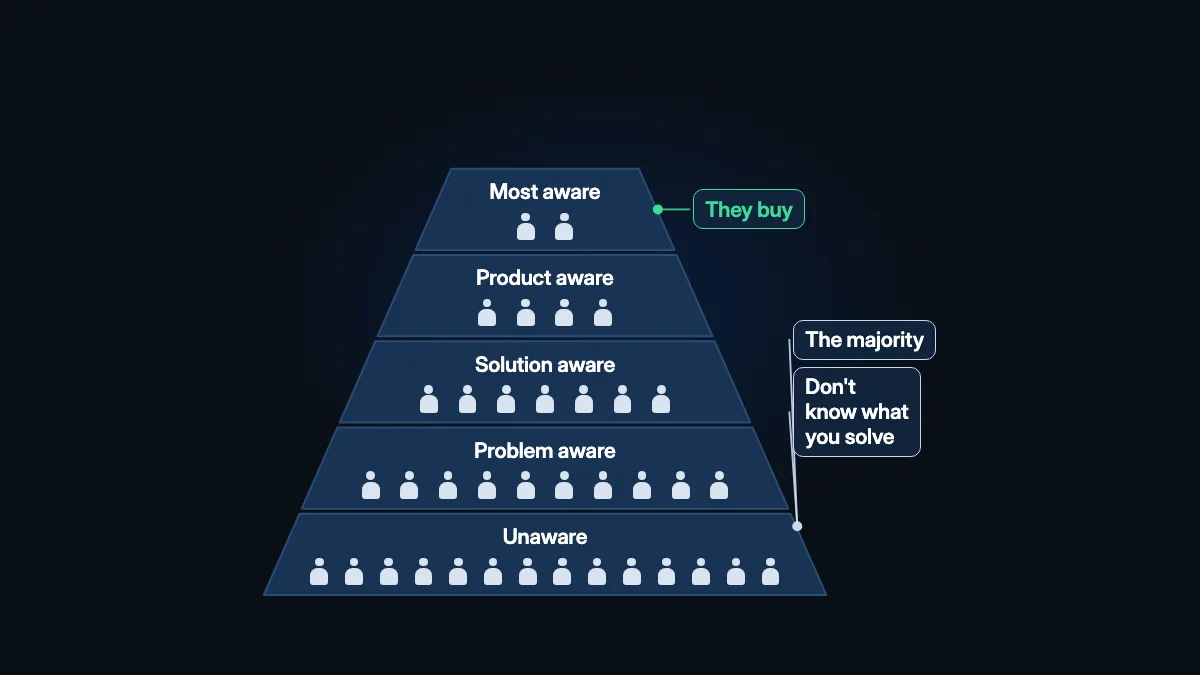
No, and this is the one thing to understand. The companies that could buy from you know different things. Some have no idea they have the problem you solve. Some know they have a problem, and that is all. Some know it can be fixed but do not know how yet. Some have already decided what kind of solution they want and are choosing who to buy it from. At the top are the few who already know who you are: they are the ones who buy.
The largest group is always the first one, the companies that do not even know they have the problem. If you send everyone the same message, you only speak well to the last group, which is the smallest.
And one fact makes it worse. In Italy, where we run most of our campaigns, there are about 6 million active companies, and about 500,000 of them are listed on Apollo and Clay, the tools almost the whole market builds its lists from: those are the companies everyone already emails. If you write only to them, your message lands next to everyone else's.
The idea is not ours. It comes from an American advertising book from 1966, Breakthrough Advertising by Eugene Schwartz, which splits buyers into five levels of awareness. Matteo explains it to clients and to the people who work with him, because it is how you decide who to write to and what to say.
What happens when you send the right message to the wrong company?
Take a company that lives on referrals and a couple of big clients, and whose owner is sure nothing is wrong. If you write "you need sales meetings", the answer is that clients come in by referral and the business is doing fine. You cannot even ask "do you have fewer clients this year?", because the owner does not see the problem.
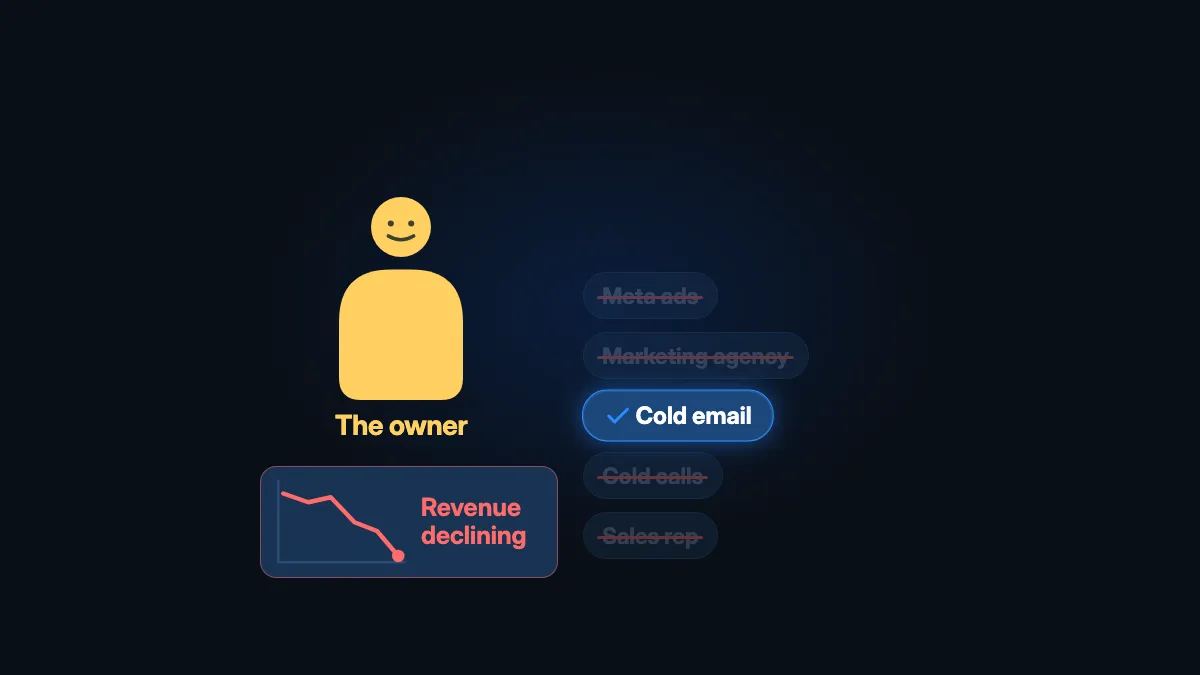
Then take the owner who sees revenue going down and referrals drying up, but does not know that cold email, cold calling or LinkedIn exist. Writing "we will book you meetings" does not work here either, for the opposite reason: this owner does not know who you are, what you do, or that email can bring meetings at all.
What should you write, depending on where the company is?
| Where the company is | What does not work | What works |
|---|---|---|
| Does not know it has the problem | any offer | stories, events, a long way round; better avoided at first |
| Only knows it has a problem | talking about the solution or about you | talking about its problem, with something about that company |
| Knows it can be fixed, not how | introducing yourself | showing with data and proof why the other routes do not fit and yours does |
| Has decided what kind of solution it wants | explaining the problem from scratch | the numbers, and what you do that others do not |
The second case is the one people get wrong most often. To a company that only knows something is wrong, you do not write "we will book you meetings". You write about its problem. For example: you look at its financial statements, you see that revenue has dropped, and you send a document that explains, by your own estimate, how it got there.
Who gets the numbers, and which ones?
The companies higher up, the ones that have already decided what kind of solution they want and only need to choose who to buy it from. The closer to the top, the more direct the offer can be. The numbers we bring are those of our own campaigns: across our campaigns, about 5.3% of the companies contacted reply.
Related pages
- Which companies should you email first
- Why referrals stopped bringing you new clients
- Why talking about your company does not get you meetings
- Can You Use Artificial Intelligence to Find B2B Clients?
